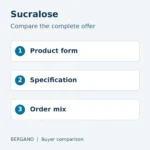
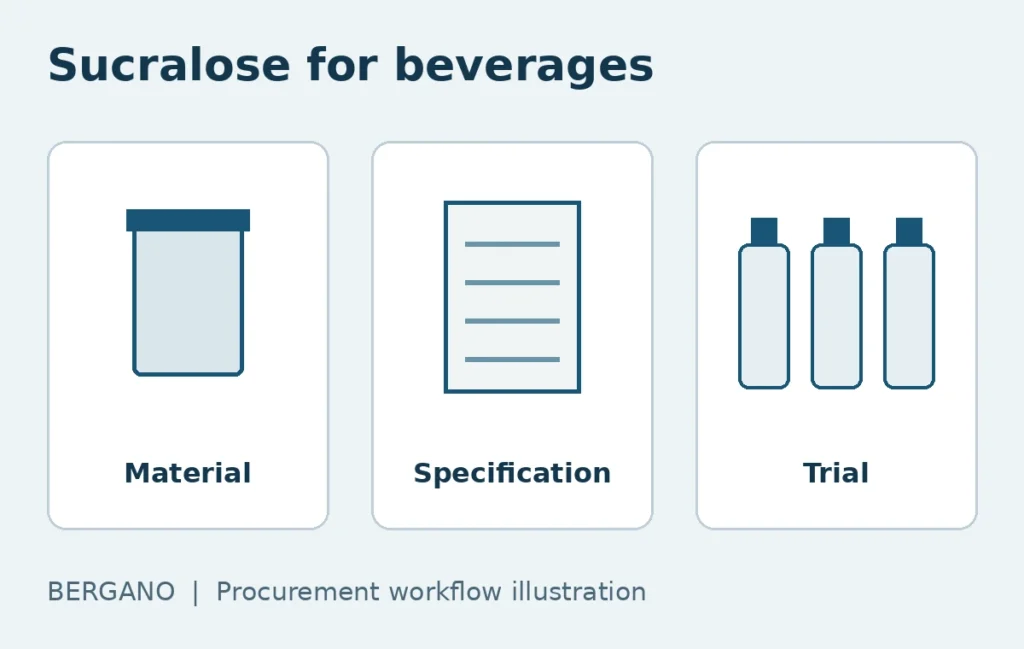
A useful sucralose enquiry connects the ingredient to the beverage, production process and purchasing plan. Before comparing prices, establish the required material form, agree on a specification and qualify a representative sample. That gives procurement and product-development teams a shared basis for approving the first order.
Bergano supplies sucralose as part of a wider food-ingredient range. Bring your sweetener and other ingredient requirements into one purchasing conversation, with low-MOQ orders and multiple products in one container.
Sucralose supplies intense sweetness, while sugar reduction can also change a drink's body and mouthfeel. Tate & Lyle's sweetener guidance discusses these separate sensory functions. Treat sweetness and texture as separate trial objectives rather than assuming that changing the sweetener will reproduce the original beverage.
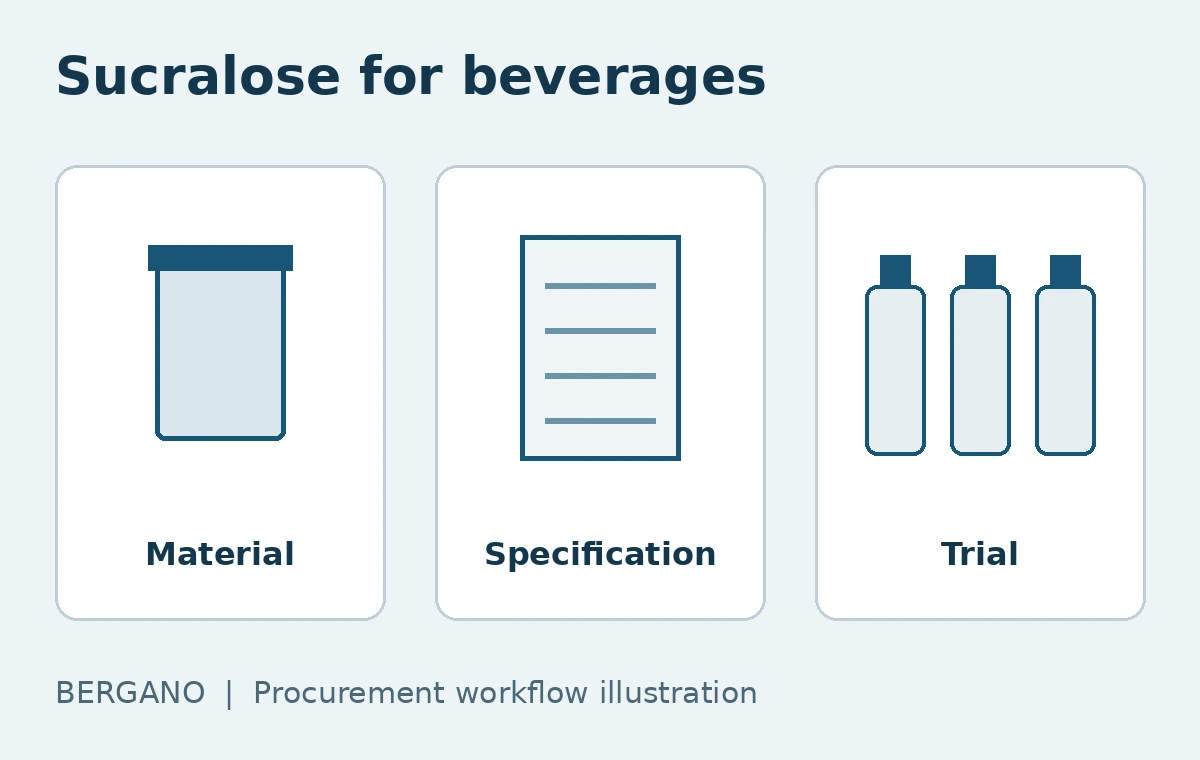
Start with a beverage and process brief
Give the supplier enough information to recommend an appropriate material:
- Beverage type, such as flavoured water, juice drink, tea or dairy-based beverage
- Whether the ingredient enters a dry premix, a syrup or the finished drink
- Product acidity, key ingredients and relevant processing conditions
- Mixing equipment, addition sequence and available dissolution time
- Intended market, required documents and finished-product acceptance criteria
Describe the problem you need to solve. A dry-blending project needs evidence about ingredient distribution and handling. A liquid beverage project needs a dependable incorporation step and acceptable finished-drink performance. Your development team should set the formulation and acceptance limits.
Confirm exactly what the quotation contains
Commercial sucralose is offered in several physical forms. Niutang's product information lists powder, granular and finer-powder options, alongside a liquid product. Availability of these forms in the market does not establish which ones a particular supplier can offer.
For a powder, ask for the product code, composition and particle-size information. Compare how the material transfers, weighs and dissolves in your equipment. Terms such as “fine” or “instant” need a measurable definition before they become an acceptance requirement.
For a liquid offer, request the sucralose concentration, its reporting basis, full composition, storage conditions and pack format. Some commercial liquid products contain preservatives. If a blended sweetener is offered, identify every component and the sucralose content before comparing it with a single-ingredient material.
Agree on a specification before approving the sample
Ask for a current specification sheet and a representative certificate of analysis, or COA. Match the document to the exact product code and producing site. A specification defines acceptance limits; a batch COA records the results or conformity statements for an identified lot.
Check identity, assay and its calculation basis, water content, relevant impurity limits and agreed microbiological requirements. The FAO/JECFA sucralose specification treats assay on an anhydrous basis separately from water and other purity parameters. Use the required specification and agreed methods to interpret an offer; a short “purity” statement leaves important questions unanswered.
Request customer-required certificates and confirm their scope and validity. Agree on shelf life, minimum remaining shelf life at dispatch and storage instructions for the offered material. Your quality team should review the documentation needed for the intended product and destination.
Run a sample trial that can support an order
Identify each sample by supplier, product code and lot. Keep its documents with the trial record and retain material for any repeat testing. Use a written procedure so that competing samples receive a fair comparison.
- Check incorporation. Record weighing and transfer behaviour, mixing conditions, dissolution time and any visible residue using the intended process water and addition sequence.
- Evaluate the actual beverage. Compare sweetness onset, persistence, flavour balance and mouthfeel against an agreed reference. A water-only tasting is an initial screen, not a finished-beverage qualification.
- Repeat the relevant processing step. Assess samples after the planned heat treatment, carbonation or other production operation rather than judging only the freshly mixed bench sample.
- Review storage performance. Use a defined sampling schedule and appropriate packaging. Record sensory changes and appearance alongside the team's analytical checks.
Keep the formula controlled while investigating a supplier change. If the material form or composition differs, document any necessary adjustment separately. A sample approval should name the accepted product code, specification and trial conditions so that the purchase order refers to the material actually tested.
Compare supply terms on the same basis
Request quotations for the same quantity, packaging, destination and delivery basis. For different concentrations or blends, compare the amount of sucralose supplied as well as the landed pack price. Include sample freight, handling and any additional processing needed at your plant.
Bergano supports low-MOQ purchasing and multiple products in one container. Ask for the available sucralose form, order-specific minimum, sample arrangements and loading compatibility. Confirm dispatch timing separately from transport and clearance.
Frequently asked questions
Is finer sucralose powder always the better choice?
No. Specify the handling and dissolution outcome your process requires, then compare available forms in a representative trial. Particle size alone does not establish the best fit.
Can the same sample approval cover every beverage?
Approval should identify the tested application and conditions. A materially different formulation or process needs a review of what additional testing is necessary.
What should I send with a quotation request?
Send the beverage brief, required material form and specification, trial and order quantities, packaging, destination and document requirements. Include the target purchasing date and expected repeat demand.
Request a sucralose specification and sample discussion
Review Bergano's sucralose product and the purchasing process. Then send your beverage and purchasing requirements so the proposed material and quotation can be checked against your project.