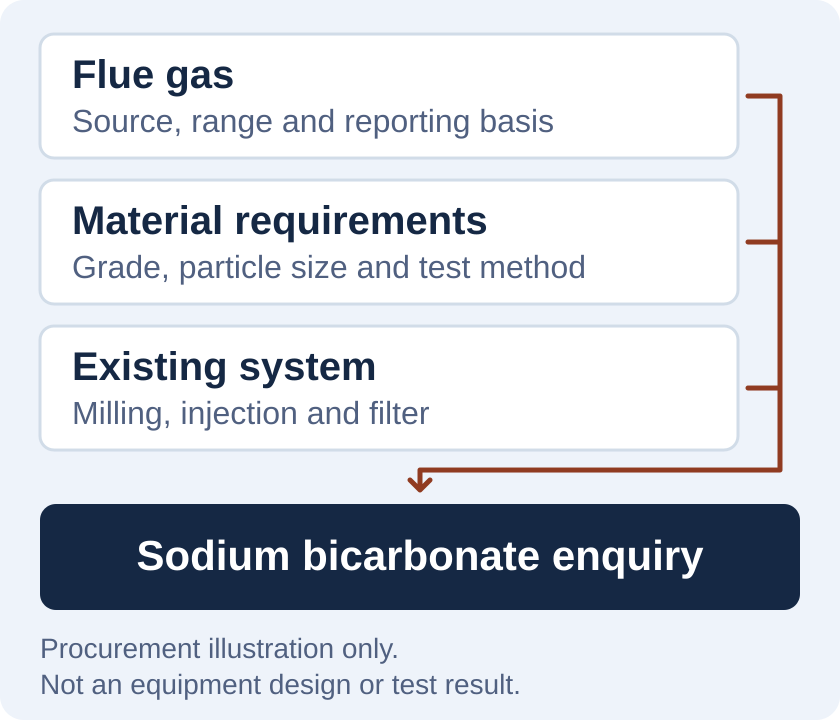
When buying sodium bicarbonate for flue-gas desulfurization, start with the project’s current specification for the material as delivered. Add the quantity, packaging and delivery requirements. Sending the same specification to each supplier makes their offers easier to compare.
1. Describe where the material will be used
Dry sorbent injection (DSI) systems can use sodium bicarbonate to treat sulfur dioxide (SO₂) and other acid gases. [1][2] A plant that mills on site may need a different incoming particle size from one that uses pre-milled powder.
If you have an existing material specification or a plant datasheet, include it with the enquiry.
2. Project data: use the units and basis in your plant records
The following details can come from existing project records. Keep the units and reporting basis with any concentration, flow or temperature figures you share.
| Project information | What to specify |
|---|---|
| Process and treatment duty | Flue-gas source, SO2 duty and any other relevant acid gases. |
| Inlet concentrations and objectives | Available normal ranges, peaks, units and the source of the objective; retain dry/wet basis and reference oxygen where applicable. |
| Flue-gas flow | Range, units and actual or standard volume basis; retain the reference temperature and pressure defined in the source document. |
| Temperature at injection | Normal temperature range and known variations at the intended injection location. |
| Existing system | Injection location, ESP or fabric filter, and any mixing or contact-time information in the design records. |
3. Distinguish incoming particle size from particle size after milling
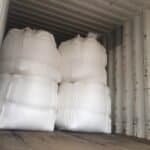
If you mill on site, list incoming and post-milling particle sizes separately so we can check against the delivery specification. For pre-milled powder, include the required particle size and test method, plus any ocean freight and storage conditions that may affect packing. Fine grades compact and agglomerate more readily, a relevant consideration when bags are under prolonged pressure in transit. See Solvay’s sodium bicarbonate storage guidance.
For sieve acceptance, include the aperture and the limit for material passing or retained. For laser diffraction, include the specified size metrics and test conditions. Our sodium bicarbonate particle-size guide explains how the two are reported.
4. A brief you can copy into an enquiry
The brief puts purchasing details first. You can attach existing plant information if useful.
| Field | Complete here |
|---|---|
| Application and incoming material specification | __________ |
| Incoming particle size, test method and specification revision | __________ |
| First order, estimated routine use or planned trial quantity | __________ |
| Bag format, unloading and storage conditions | __________ |
| Delivery destination, required date and documents | __________ |
| Optional attachments: milling setup, post-milling size and available plant data | __________ |
5. How we review your enquiry
Bergano checks available industrial-grade sodium bicarbonate against your incoming specification and confirms packaging and delivery arrangements with you. The project’s engineering team sets the plant’s material requirements and validates dosage and treatment performance.
Send Bergano your specification and delivery requirements so we can review what you need as delivered.
Public technical references
[1] Solvay SOLVAir, Targeted Pollutants, sections on SO2 and acid gases.
https://www.solvay.com/en/brands/solvair-solutions/targeted-pollutants
[2] Babcock & Wilcox, Dry Sorbent Injection Systems, PS-451A (©2010), PDF pp.2–4, reagent selection, configuration and performance-factor note.
https://www.babcock.com/assets/PDF-Downloads/Emissions-Control/PS-451-Dry-Sorbent-Injection-Babcock-Wilcox.pdf
The technical references explain the application and material-selection factors. Bergano prepared the enquiry brief above.